House House’s Big Walk uses pitch darkness and lost connections to make its co-op puzzles feel unexpectedly personal.
When co-op turns into survival
Big Walk’s most unsettling moments don’t come from monsters. They arrive when the group disappears into the dark and the only way to find your friends is to call out and hope someone answers. House House’s co-op adventure makes isolation feel personal, giving its playful puzzles an emotional edge that’s hard to get from a conventional scare. The threat isn’t a creature waiting around a corner. It’s the sudden loss of the people who’ve been making the walk feel safe.
The game brings together as many as 12 players to explore the outback, solve obstacles, and make sense of vague landmarks. That setup gives the group room to improvise, but it also means progress depends on people noticing the same clues and agreeing on what to do next. The fun comes from working things out together, along with the familiar friction of a real group: side arguments, running jokes, and the occasional debate over movie opinions. That social texture is part of the design, not a break from it. A detour can become its own entertainment when everyone’s involved in choosing it.
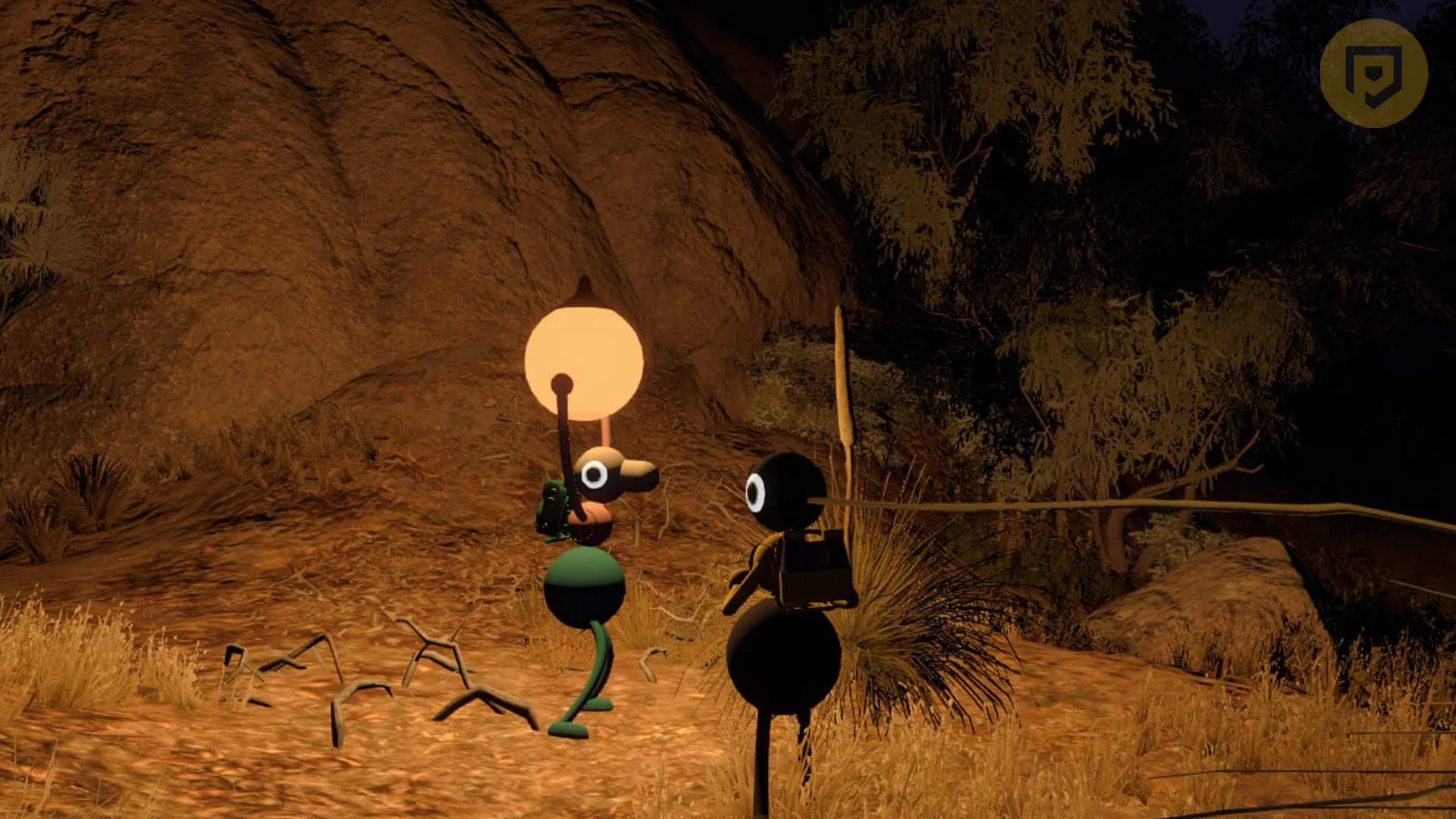
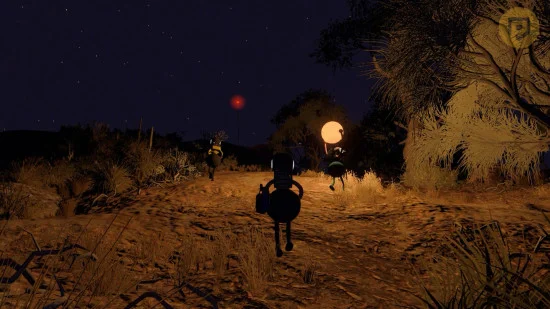
Then night falls. Players can lose sight of one another, and useful tools such as a torch, laser, or attention-grabbing instrument may not be available. Without a clear route back, the group has to rely on voices, movement, and whatever they can remember of the terrain. Small decisions take on more weight: who should move, who should stay put, and whether that sound came from a friend or the surrounding wilderness. The game turns familiar co-op habits into a source of uncertainty.
A misplaced lamp can be enough to split everyone up. The darkness is near total, and there are no quick respawns or fast travel points to erase the mistake. That absence makes a wrong turn feel consequential without turning it into a conventional punishment. For a while, the game leaves you alone with the sounds of nature and the uneasy question of how to get back. It’s a simple setup, but it asks the group to sit with the consequences of losing track of one another.
The fear of losing contact
That stretch changes what the player is thinking about. The search for a landmark gives way to a more basic need: communication. You’re no longer just trying to solve the next obstacle; you’re trying to establish that someone else is still nearby and listening. After spending hours trading jokes and solving problems with friends, being cut off from them makes their presence feel newly valuable. This is more significant than it looks: the game makes companionship part of the practical challenge.
Big Walk doesn’t treat every obstacle as a conventional puzzle, either. Sometimes House House seems content to let the group pause, sit on a couch, listen to music, or talk for a few minutes. Those quiet interludes make the isolation land harder, because they give players time to settle into each other’s company before the game disrupts it. The comfort of being together is something the game lets players notice by taking it away. Here’s the thing: the quiet can do more emotional work than another elaborate contraption.
That contrast also changes how the group’s ordinary chatter reads. A running joke or a disagreement over direction might seem incidental while everyone’s together, but it becomes part of the shared history that players carry into a separation. The game doesn’t need to explain that bond in a speech. It lets the player feel the difference between an occupied voice channel and silence. And yet, the fear remains low-key; it comes from uncertainty and distance rather than a sudden spectacle.
Robert De Niro’s line in Michael Mann’s Heat—“I'm alone, I am not lonely”—offers a useful counterpoint. Big Walk’s darkness can leave a player alone, but the larger experience is about the friendships waiting on the other side of it. The line also points to a tension the game understands: solitude and loneliness aren’t the same thing, but losing contact can make the distinction feel fragile. A player may be physically by themselves while still relying on the group’s shared map, habits, and memory.
Why the group matters
The puzzles and odd contraptions give Big Walk its structure, but the people sharing the walk give it its staying power. Getting lost is frightening; getting lost while your friends argue over which way to go turns that fear into a story you can laugh about later. That mix of vulnerability and companionship is what makes the game’s quiet horror stick. The same separation that creates anxiety can also make a reunion feel earned, because the players have had to find their way back to one another.
If you’re working in this space, the useful lesson is that co-op tension doesn’t have to come from adding a powerful enemy or raising the stakes through spectacle. Big Walk makes familiar social habits do the work: listening, calling out, remembering where people went, and deciding whether to wait or keep moving. That approach depends on the group being willing to talk and play off one another. If they are, even a pause in the action can carry weight. If they aren’t, the same stretch may feel like time spent waiting for someone to respond.
What the quiet horror leaves behind
Big Walk’s design suggests that isolation can be effective when it interrupts a strong sense of company. The game first gives players reasons to notice each other, from shared problem-solving to unplanned conversation, then makes those connections useful when the terrain becomes hard to read. (And this is the part most people overlook.) The darkness matters because the players already have something to lose: the easy, ordinary access to their friends.
That makes the game’s horror less about what might be hiding in the outback than about how quickly a group can become scattered. The fear doesn’t need a monster to explain itself. It needs a missed call, a vanished light, and the possibility that everyone’s working from a different idea of where to go. A small absence. Then another.
What this means for you as a player is that the most memorable moments may come from the group’s response, rather than from any single puzzle or tool. Big Walk can’t guarantee that every group will find the same warmth or tension in its pauses; social play depends on the people at the controls. But when the group clicks, the game’s isolation gives ordinary friendship a sharper outline. That’s a modest idea, handled with unusual confidence.


Discussion
Sign in to join the discussion.